2020 Tax Checklists

It's that time of year, and tax time is upon us. We are looking forward to seeing you all again.

We have included our tax time checklists to help you get your information together.


If you would like to book an appointment or have any questions, do not hesitate to contact us today.

Individual Tax Checklist 2020
Rental Property Checklist
Business Tax Checklist

Adviser fees – What are you actually getting?

As accountants a question we often get asked is “Is this a good investment” or “What do you think of this investment idea”? As an accountant who is also very interested in all aspects of finance, investing and ASX shares more specifically, I don’t mind having a look at people’s portfolios. In fact, in order to complete a tax return, it is often an essential part of my job, and one I happen to really enjoy. Unfortunately for me (and countless more of my accounting brethren) accountants are not allowed to offer any kind of recommendation or financial advice. Regulations, as they currently stand, prohibit accountants from offering specific buy or sell recommendations. Anything beyond a simple “it looks good” can be considered too specific and construed as stepping on the toes of planners/advisers.              

Generally, though the first thing I tend to notice when looking at full year portfolio reports from prestigious brokerage and financial advice firms, are the exorbitant annual “retainer fees” or “ongoing advice fees”. These fees are sometimes in the thousands of dollars and I can’t help but ask myself “what on earth are people getting for all of these fees”? Sure, the reports are nice and detailed, and the offices are probably very well equipped, no doubt inner city or CBD located, and they probably validate your parking when you go in for a meeting. However, none of that adds up to $5,000+ in annual fees. For that I personally would expect market beating performance, and insight leading to investment returns that make that $5,000 look like money well spent.

Don’t get me wrong I am not suggesting this advice be free, far from it. Initial portfolio construction, if correctly tailored to a client’s risk tolerance and expected investment returns, takes time and effort and you should have to pay for it. What I am talking about is charging people thousands of dollars to “manage” a portfolio consisting of one or more big bank shares, a Rio Tinto or BHP, and a Telstra thrown in for a bit of diversification. Not only is there not much in the way of “ongoing” advice, the portfolio I just described did not require any real insight or thought on behalf of the broker/adviser, you should not have to pay large sums of money for an adviser to collect dividends and interest on your behalf or sell shares at a loss at the slightest hint of market volatility. Too often the portfolios that I see are constructed of a few blue-chip shares, an Exchange Traded Fund (ETF – basically a managed parcel of shares that tracks an index) and cash, not much in the way of groundbreaking, market beating insight!

Another point to note is that, in the current ultra-low interest rate environment be wary of any adviser recommending a large percentage of your portfolio be held in cash. Whilst some cash kept in reserve is always good so that you can capitalise on opportunities (the current corona virus induced market selloff being a prime example of this) that arise in the market, at the moment even the best term deposit will only earn you 1.5% and the latest figures on inflation indicate that the rate of CPI (Consumer Price Index) is 1.8%. In simple terms this means that each dollar earnt is actually worth less in real purchasing power (1.5% < 1.8%) this is before tax as well! So be especially aware of advisers promoting a very high cash position and charging you handsomely in the process.      

The reasons we here at Leddy’s & Associates feel so strongly about this are two-fold

  • The best portfolios in terms investment returns the we deal with here are from people who manage their own portfolio. I will grant you this takes discipline and time and isn’t for everyone. You need to research stocks and analyse reports, however there are various subscription services e.g.: Barefoot investor, Motley Fool Share advisor that you can avail yourself of for a small fraction of the cost to do this for you.

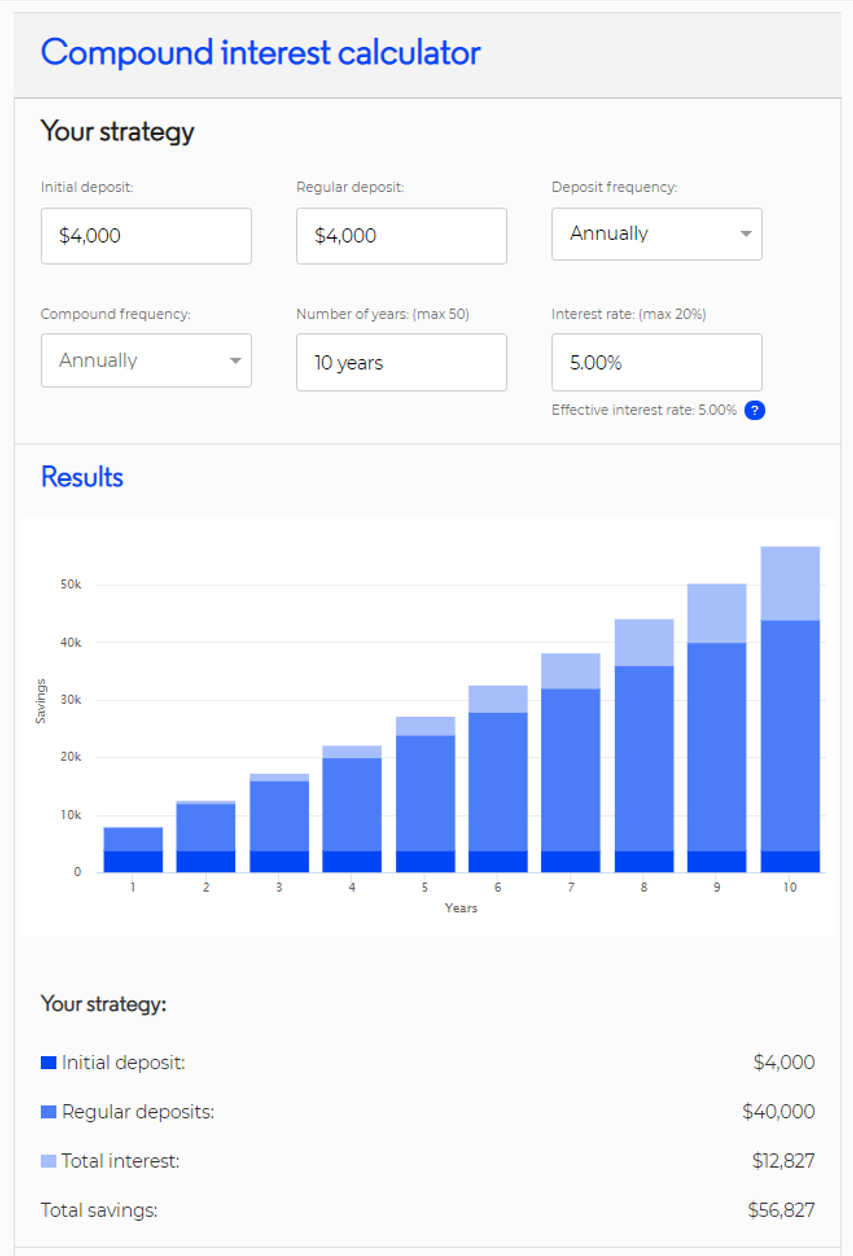
  • The long-term wealth destruction, on a compounding basis, of enormous fees is definitely worth considering. Did you know that $4,000 reinvested every year as opposed to paid in fees, at a rate of return of 5% (The ASX 200 index returns, on average, 10% over the last decade) will eventually become $56,000? Compounding is indeed a powerful tool.

In summary, the point of this article is not to tell you to leave your adviser rather it is to get you thinking about how much you may pay brokers/advisers and ask yourself this important question “can I get the same result for a fraction of the cost? It is important to note that not all advisers charge these crazy amounts of money and the vast majority of them earn their fees. After reading this article ask yourself if you are getting value for money on your “investment”.

Written by Glenn Barea

Interest Calculator

Your job description as Director

Most business owners know that every member of their team needs a job description, which should include:

  • Clearly outlined responsibilities and tasks

  • Some specific and measurable KPIs (Key Performance Indicators)

  • A set of clear expectations around core competencies and behaviour

When a job description is clearly documented, it’s much easier to monitor and measure performance. However, as logical as this seems, many business owners fail to do this for their own role as Director of the business.

So, as Director, what should be in your job description?

The most important function of a Director is to maximise shareholder value. This means carrying out activities that drive up returns and business value; by working smarter, not harder.

Your key responsibilities include setting the vision and strategy, managing and mitigating risks, growing the business, establishing the right business structure and holding the CEO (who may also be a Director) to account.

How much time are you dedicating to working ON your business?

To give a general indication… as Director, you should spend an hour or two every week working ON the business. In addition to that, every quarter you should dedicate half a day to ongoing strategy planning and take one to two days every year for an annual off-site planning session or retreat. This is to remove yourself from day to day distractions to do some serious ‘blue sky thinking’.

As Director, you still need accountability.

Appoint someone independent to ensure you adopt best practice as a Director. There are several ways to get accountability. You could establish a quarterly advisory board (with an independent chairperson). Or, you could engage an experienced facilitator to coach you regularly to ensure you’re meeting your objectives. Having an independent accountability process in place will ensure better planning, better decision making and faster progress.

Remember, you’re not exempt from meeting the requirements of your Director role. Like every other role in your business, you need a job description for your role as Director, and it should have clear responsibilities and tasks with KPIs so that you can monitor and improve performance.

So, if you don’t already have a job description, set that as an important task, with a due date, and start thinking about who will hold you accountable.

Get in touch for information about our Quarterly Coaching service.

Employee engagement is key to business success

4cOXm2A8RN5e5Gfwfv8VJ9-active-activity-adult-1430116.jpg

Companies with engaged employees are 21% more profitable, according to research by Gallup.

Managing your employees’ performance, and keeping them engaged with your business vision, is key to the present and future success of your business. Your people are one of the most important assets in the business, and you need them to be motivated, productive and hitting their targets.

But how do you manage employee performance in a way that promotes this kind of productive engagement, while delivering the value you need in the business?

Driving true employee engagement

People are diverse and complex. We don’t all react in the same way to being managed in our work, so there’s no ‘one size fits all’ approach to employee performance.

The key is to get to know and understand your team, so you have a better feel for what motivates them, how they like to be rewarded and their own personal goals.

To improve your employee performance and engagement:

  • Hire the right people – this may sound obvious, but good performance starts with having the best people for the job in the team. Make sure any new hires understand your vision and share your core values. If employees already fit your ideal personal profile, there’s less work to do when aiming to manage their performance.

  • Set clear expectations and targets – if you set defined targets for employees, there’s a clearer performance framework for them (and you) to work within. Setting targets and goals gives impetus to their work and allows you to put a timeframe around when, and how, these goals will be achieved.

  • Carry out performance reviews – formalised performance review meetings can be a good way to track performance and have meaningful conversations with employees. But, be aware that some people can resent these formal reviews and will view them as being ‘put on the spot’. The key is to know what works for your people. Tip: Make it a two way conversation with opportunity for your employee to provide feedback on areas in the business that could be improved or ideas they have. Your staff will feel listened to and valued and you’ll gain valuable insight.

  • Give on-the-spot praise - many millennial and younger Gen Z employees prefer on-the-spot praise and feedback to a formal review process. And this approach can work well. If a team member does a great job, tell them and be transparent around your praise. And offer rewards that actually resonate with what employees want.

  • Provide opportunities to develop – career development is something people increasingly expect from their employer. Providing the support, education and guidance needed to excel will benefit both parties; your employee gets to develop their career, and your business gets the benefit of their additional talents.

If you want to kickstart your employee performance, start by creating a culture of engagement. Nurture, measure and reward good performance, so your team are aligned with your business vision. Contact us today!

Strong staff engagement results in strong business performance.

The Corona Virus: What does it really mean to your portfolios??

You would have to have been living under a rock for the past few weeks to not have heard of the corona virus, otherwise known as the Wuhan Virus, emanating out of the Wuhan province in China. It has caused mass panic in China and prompted the countries authorities to place all affected areas into lock down. Despite their best efforts the virus has managed to make its way to Europe, the USA, and even to us here in Australia.

What you have also likely heard is that this outbreak is going to absolutely decimate world markets. Phrases like “ASX to drop 1pc in global sell-off”, “ASX set to follow Wall Street lower as Corona Virus panic grips markets” or “Corona Virus fear grips world markets”. There is no doubt that fear has well and truly taken hold of world markets. However, as investors we need to sit back and take stock of what is really going on, what long term impact will this have on your portfolio, if any?

To know the answer to that question with any degree of certainty would require a crystal ball  and a level of sorcery that I simply don’t possess, so I guess I’ll just leave the wild predictions to the “experts” who get paid enormous sums of money to come up with such pearls of wisdom as:

·         “Sell everything” - Royal Bank of Scotland (RBS) advised clients in January of 2016 in response to a small correction of global markets

·         “Pension funds and 401k’s (US retirement accounts) set for worst fall in recorded history” – US mainstream media outlets In response to Donald Trump winning US election in November 2016

·         After the Sudden Acute Respiratory Syndrome (SARS) outbreak in 2003 investors were panicking about airline stocks, and tourism businesses. It was, apparently, going to herald a new age of telecommuting and the end of face-to-face meetings.

The truth is anyone who took the advice of the RBS in 2016 paid an enormous opportunity cost of lost potential gains from not staying invested in the market. The truth Is the election of Donald Trump had the opposite effect to what “experts” predicted, and SARS in 2003 – You guessed it…. The “experts” were wrong again.

The truth is that in 2003 during the SARS outbreak the S&P 500 (main US market index) dropped 8.3% and stocks related to discretionary spending and emerging markets (particularly China) under performed. At the same time, the price of gold jumped 4.8%. The good news is that over the next six months after the scare, the S&P 500 more than made up for its losses, gaining 18.6%.

More recently, the Middle East Respiratory Syndrome (MERS) corona virus spooked investors starting in late 2012. Between November and December 2012, the S&P 500 dropped 0.8% while the price of gold increased 0.5%. Notably though however, the S&P 500 bounced back from the scare much more quickly, gaining 15.1% over the next six months. 

Importantly Bank of America healthcare analyst Yang Huang believes that the impact of this recently outbreak of Corona virus could be less severe compared with the severe acute respiratory syndrome (SARS) outbreak in 2003, as the Wuhan virus appears to be less contagious and less fatal. Tom Essaye, founder of Sevens Report Research, notes “From a market standpoint, since this disease is closely related to SARS, I think the market reaction to the SARS outbreak gives us a good template to follow,”

In simple terms then what is that “template” and how do we follow it? A fair question as by now some of you might be thinking “Yeah, but this time might be different”. It might also have been different after:

·         It might have been different after the GFC.

·         Or the dot.com crash.

·         It might have been different after Brexit.

·         It might have been different after Trump.

·         Or December 2018, when stocks fell meaningfully just before Christmas.

And yet here we go again. There will be people lining up, this morning, to sell once the market opens, influenced by fear the headlines and the talking heads. “At least I did something” they’ll tell themselves. Not like those suckers who held on while their portfolios fell, and…

And?

As I pointed out earlier, I possess no crystal ball, nor a time machine. I can’t tell you what happens next, in either the short term or the long term. I’d be lying to you if I said I did. But there has been no time in history — EVER — when developed world stock markets have failed to scale their previous highs and go on to set new ones. There has been no time when adding money to the market, regularly, has been a bad idea (indeed, continuing to add during the depths of the GFC turned out to be incredibly lucrative).

I don’t know how the ASX will close today. I cannot say whether tomorrow will be better or worse. Your portfolio might be 2% lower — or higher — in a month’s time. What I do know is that history is, very strongly — on the side of the patient, long-term, dollar-cost-averaging investor. Markets tend to move violently on the back of 2 emotions: fear and greed. Warren Buffet, perhaps the world’s most famous investor has a theory on this and it is simple “be fearful when everyone else is being greedy and be greedy when everyone else is being fearful”.  

Sure you could try and react to the daily headlines. Sell. Buy. Buy. Sell. Attempt to time the market for short term gain. Try to be smarter than the other guy. Just remember how that’s turned out… literally every other time.

Written by Glenn Barea

Reference: Yahoo Finance, Motley Fool.